
Listen to our Spotify podcast about this article:
By Lori Currie
An Idaho project for Seattle-based E. Cobb Architects Partners arrived unexpectedly. The firm had just completed the design process for a new home in Seattle when the clients had a last-minute change of heart–or more aptly, they desired a change of scenery–and asked if fresh plans could be drawn up for a home in Sun Valley, Idaho. Principal Eric Cobb and his team embraced their new marching orders with aplomb.

E. Cobb Architects Partners Folds An Elkhorn Landscape Into A Harmonious Haven
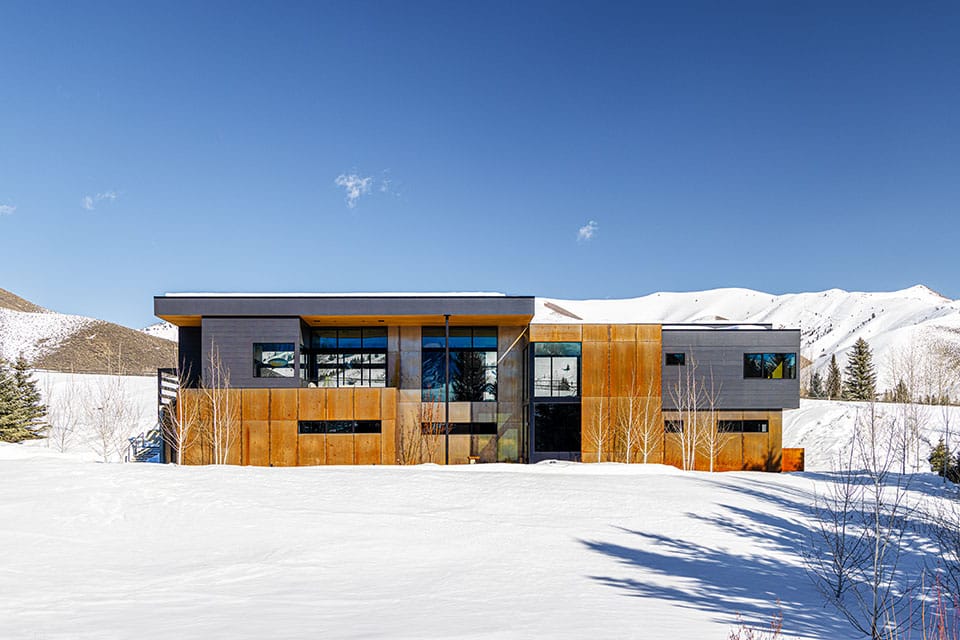
“We immediately jumped into the opportunities of the Idaho site, which were quite different than the Seattle site,” says Cobb. “The way this particular project engages outdoor space is unique, enabled by careful sculpting of the topography and building envelope.” As with many families in Sun Valley, the clients are big outdoor enthusi-asts and wanted to allow the landscape to be part of the house, not just ring the exterior of it. The team designed a two-story 5,637-square-foot home with four bedrooms and four-and-a-half baths; several outdoor vignettes visible on the property are collaborations with local land-scape architects BYLA and installers Native Landscapes.
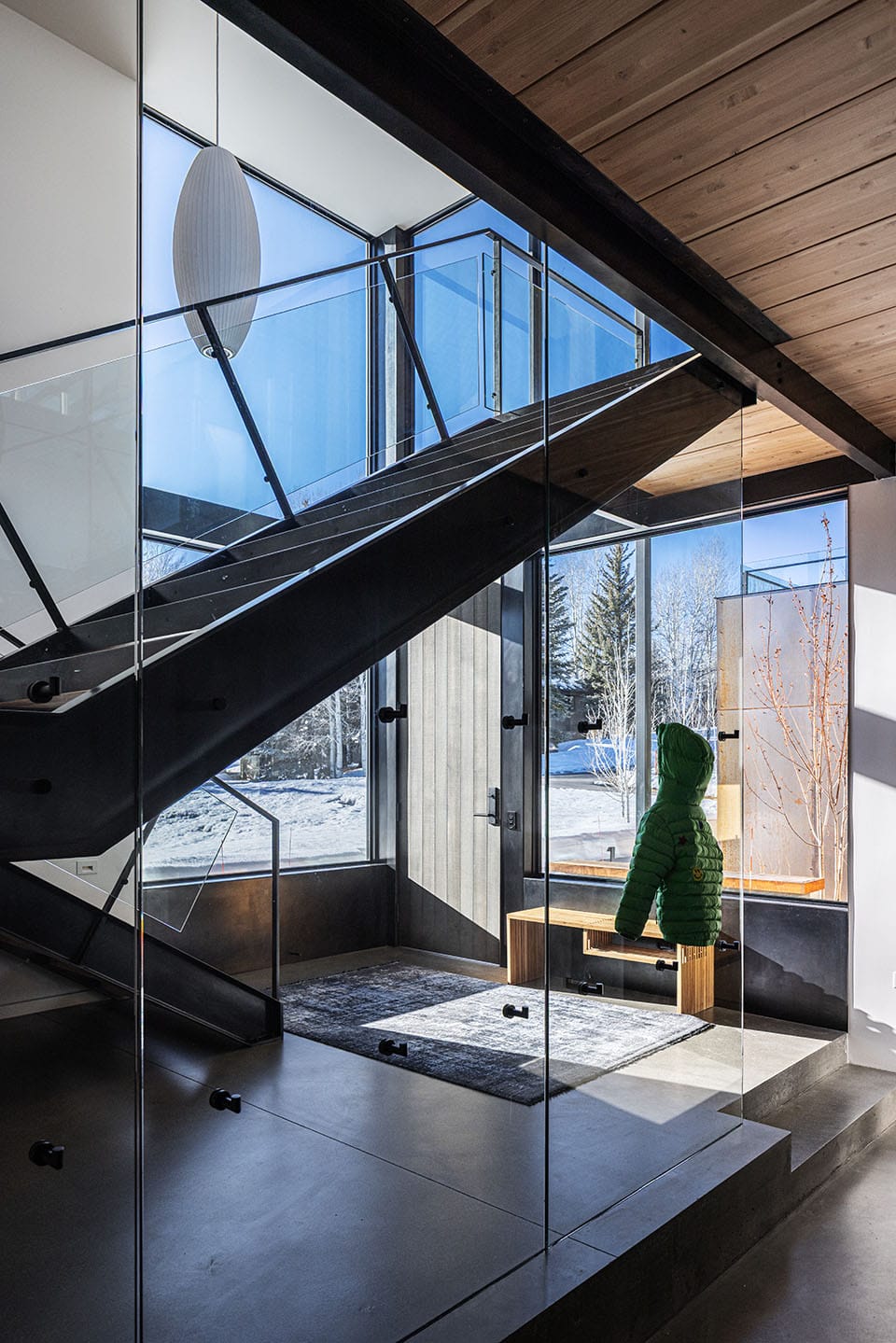

E. Cobb Architects Partners is recognized for designing modern space-defining elements that are both structural and sculptural, as reflected in projects throughout the Mountain West and also the East Coast. In this project, a dramatic double-height glass entry displays a sculptural steel and wood staircase, escorting you up to the main living level. Within this event, there are a few “quietly complex” architectural techniques that make the entry experience special, says Cobb. First, as the stairs ascend, the same assembly of steel and wood creates a bridge at the landing, spanning between the great room and primary suite. Together with the staircase, this creates a unique sculptural shape, visible from above and below, filling the volume of the glass entry. Second, beneath the stair, there are two expansive glass panels that separate the entry space from the linking hallway, which leads to a rec room, several bedrooms, and a hard-working mud-room. These glass panels have coat hooks ingeniously mounted to it that are just for guests, resulting in “a fun, creative and non-precious entry experience, while quietly separating the entry from private spaces,” says Cobb.

“We immediately jumped into the opportunities of the Idaho site, which were quite different than the Seattle site. The way this particular project engages outdoor space is unique, enabled by careful sculpting of the topography and building envelope.”
–Eric Cobb, Principal, E. Cobb Architects Partners
The arrival point upstairs, flanking the steel and wood bridge, is a glass-lined hall separating the living room of the home from the more primary suite. The eye is immediately drawn to an exterior glass-lined court-yard, visible from three sides, with several boulders coming right into the home. “The experience of climbing the stair, seeing the rock garden, and then traversing into the great room becomes a fantastic everyday event,” says Cobb, “while at the same time, seamlessly creating separation between the great room and the primary suite.”
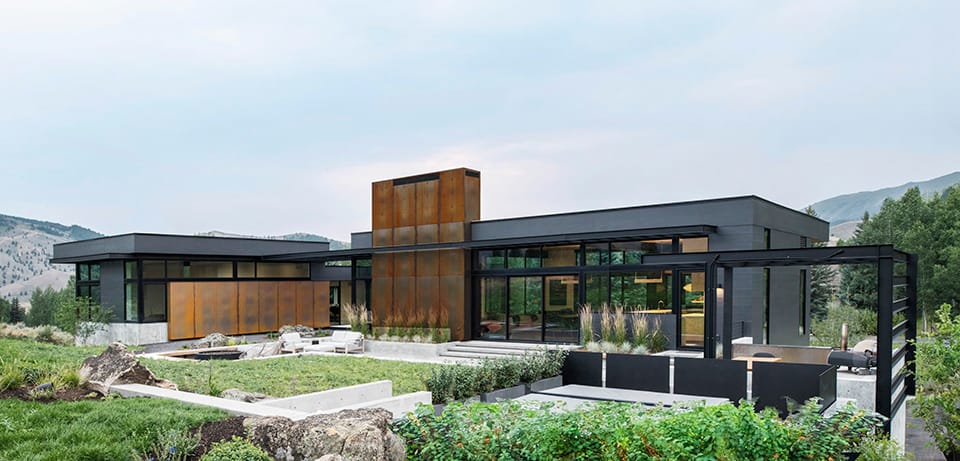
The expansiveness of the lot gave E. Cobb creative license to push the envelope. “It’s an opportunity you don’t often have in residential architecture, because many sites don’t afford the space to pull things apart that far,” says Cobb. “When you have the opportunity to stretch things apart, you gain the ability to create striking and unexpected relationships with the landscape, inside the home.”
“When you have the opportunity to stretch things apart, you gain the ability to create striking and unexpected relationships with the landscape, inside the home.”
–Eric Cobb, Principal, E. Cobb Architects Partners
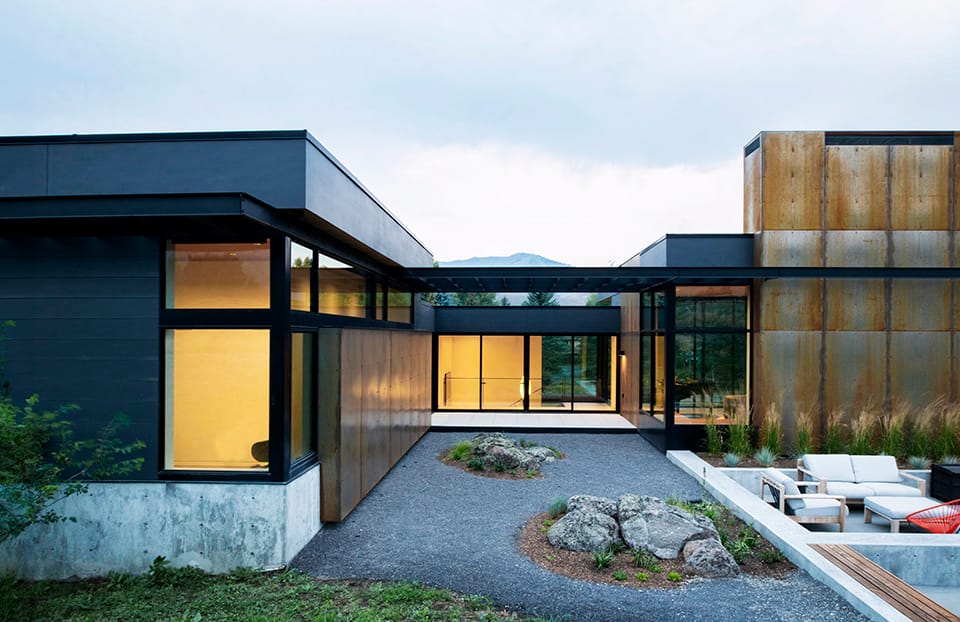
Having gone through a design process previously with this client, Cobb and his Project Architect Joe Wilhelmi knew they had a shared sensibility of appreciation for natural, honest materials. “Sometimes architecture ends up going down this path where it’s designing for effect,” says Cobb. “With this client, we had fantastic alignment. The simplicity of the concrete floors and the fir wood ceilings used throughout really allows the materials to express themselves. You can feel the integrity of the materials used.” The polished concrete floors provide a bit of natural variation; the color tone has some warmth, and the floors don’t look machined. They carry the mark of the maker in the varying aggregate and subtle irregularities from the pour. The floors are heated, and being concrete, they can also take heavy wear and tear. The natural light bouncing up off the polished floors onto the wood ceiling gives the whole experience in the house a glow. As the sun goes down and the artificial lighting takes over, the warmth increases. Likewise, the colors of the surrounding landscape and the filtered light from the sun become amazing players of an elevated experience inside the house.
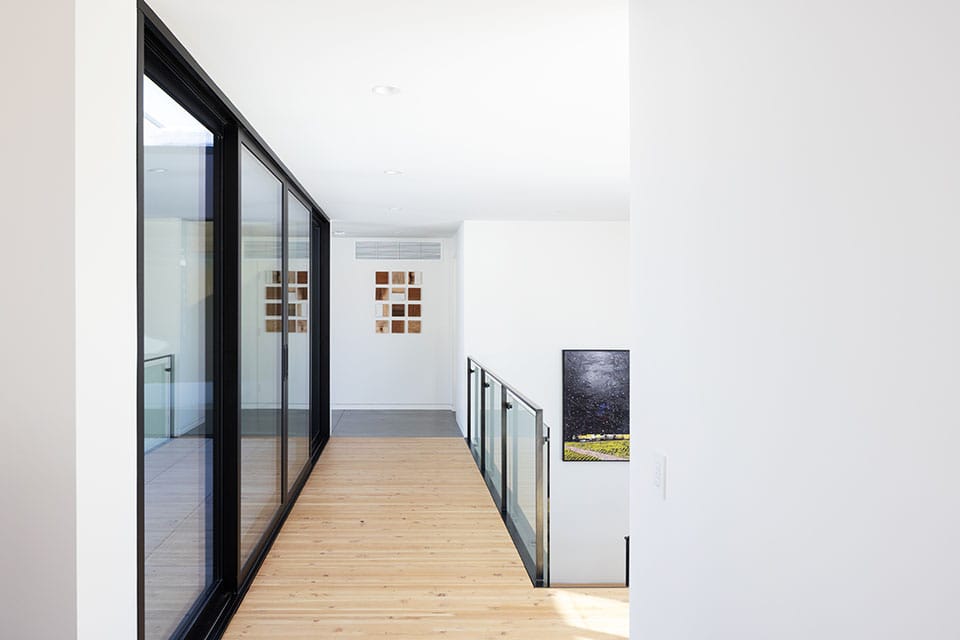
A similar strategy has been employed on the exterior of the home in the use of Corten steel siding, which will continue to oxidize for a few years, turning deep orange and umber shades until it stabilizes. “The oxidation is a natural process, and it won’t be perfectly even,” says Cobb. “It will have irregularities in it, and it’s not entirely predictable.” It’s very compatible with the fiber cement shiplap siding and fir wood used on the exterior soffits. A sunscreen awning acts as an architectural device that runs from the kitchen across the living room and over the indented courtyard. This assembly also establishes the overhead language that’s used above the outdoor dining area and again on a terraced area with an outdoor barbeque, perfect for dining al fresco.
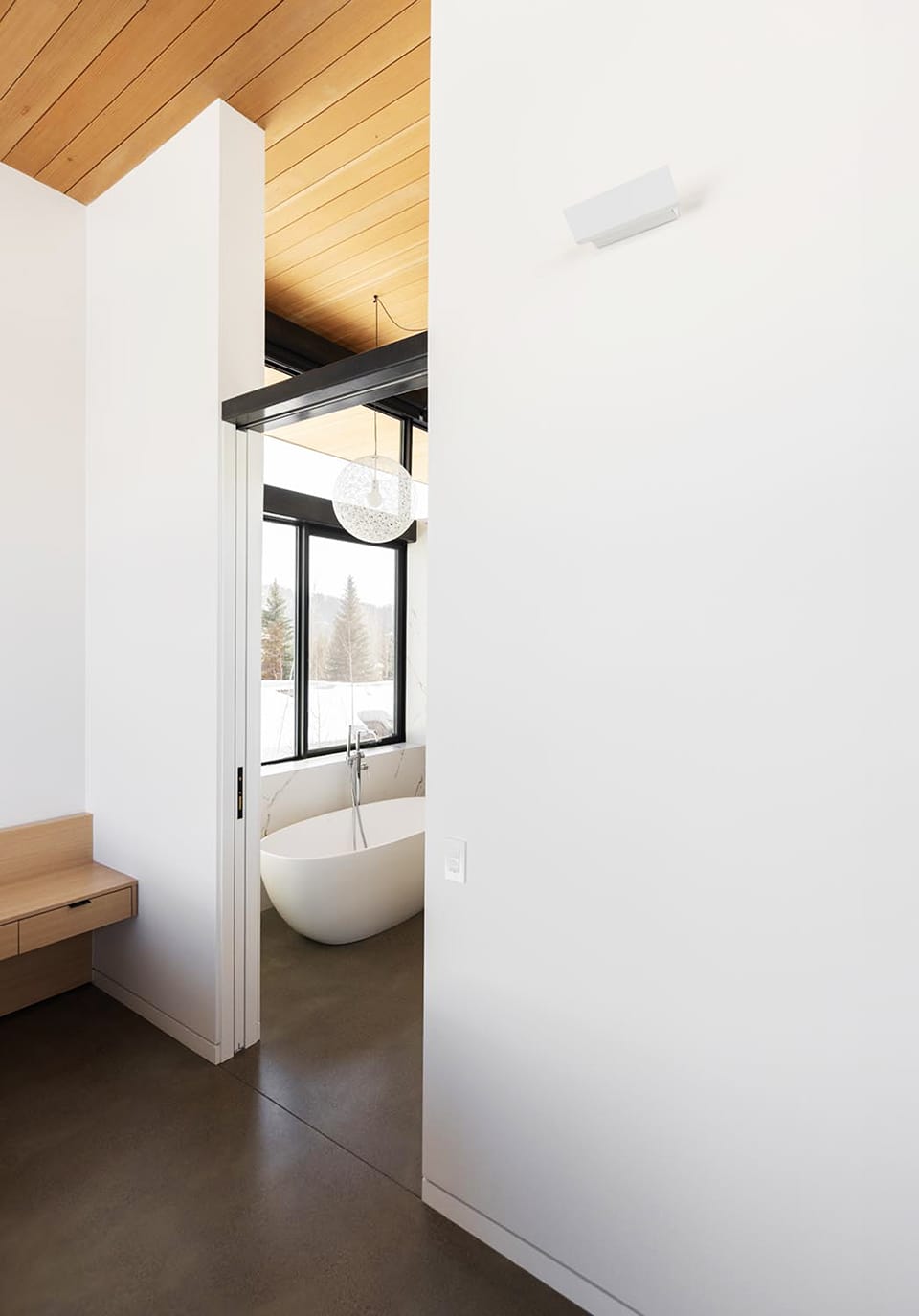
“With this client, we had fantastic alignment. The simplicity of the concrete floors and the fir wood ceilings used throughout really allows the materials to express themselves. You can feel the integrity of the materials used.”
–Eric Cobb, Principal, E. Cobb Architects Partners
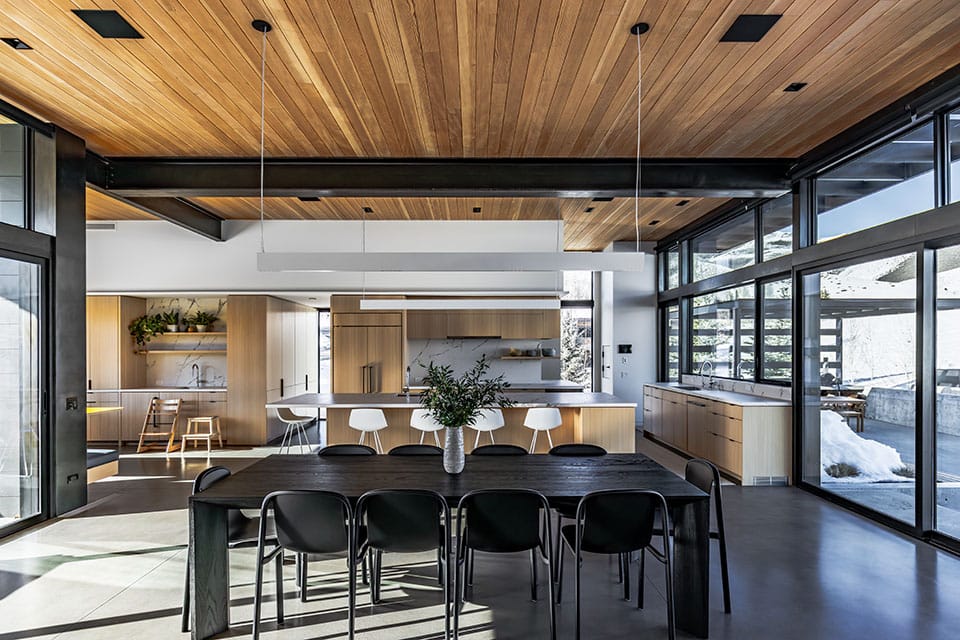
The patios on the west and east sides of the home frame the open kitchen and dining room. In the kitchen, a tucked-away pantry (complete with dumbwaiter from the garage below, a clever client request) hides the essentials of meal prep for little ones. The island features Dekton Cairos countertops and anigre (an African hardwood) casework, bordered by a cozy breakfast nook and a secondary prep sink. Then there’s the dining room with living room beyond, where a steel-clad fireplace takes center stage. But the space between the kitchen and living room is intentionally quiet, design-wise. Black steel beams and window frames, with a black dining table and black chairs define this space, with little else. “One of the opportunities in having our own interiors staff in our office is that we can conceptualize how the language of furnishings can engage different parts of the architecture early on,” says Wilhelmi, who worked with Amber Rodriguez on the interiors. There’s a calmness in the way the furnishings and the architectural bones talk to each other in the dining space, blurring the boundaries between architecture, structure, and interiors. The formulaic models for architecture traditionally don’t fully engage landscape and interiors, but E. Cobb focuses on these precise moments of overlap. The architects intentionally make it difficult to identify the professional boundaries. “We try to elevate these experiences and really get eyes on it early in the design process,” says Cobb.
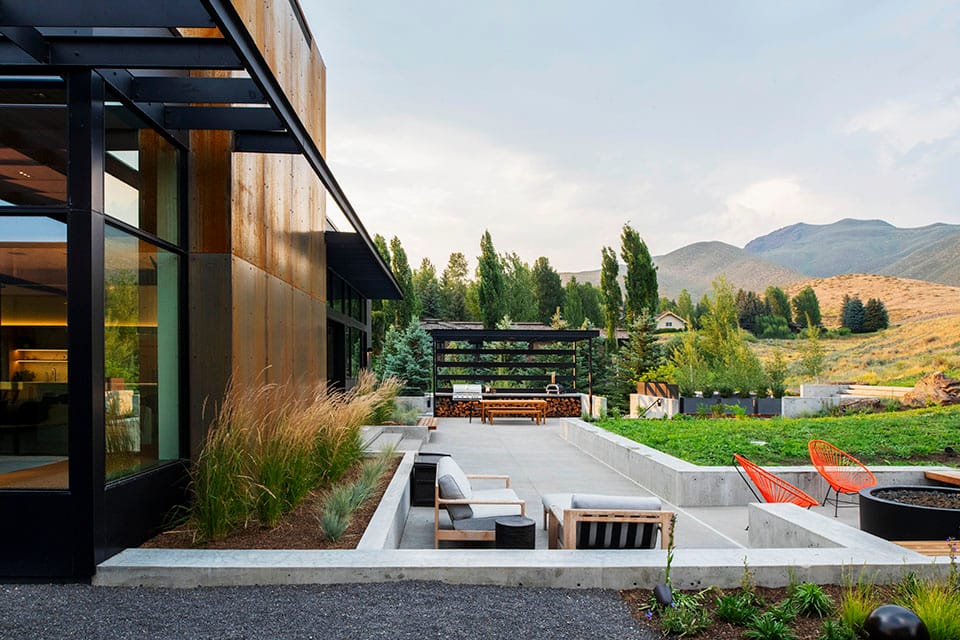
To the casual observer, Cobb likes all the design details to look very matter of fact and straight-forward. “They’re very controlled so the detail never gets out of hand,” he says. “It never takes on a random, accidental aesthetic. It’s controlled with a logic that respects the making.”
“They’re very controlled so the detail never gets out of hand. It never takes on a random, accidental aesthetic. It’s controlled with a logic that respects the making.”
–Eric Cobb, Principal, E. Cobb Architects Partners
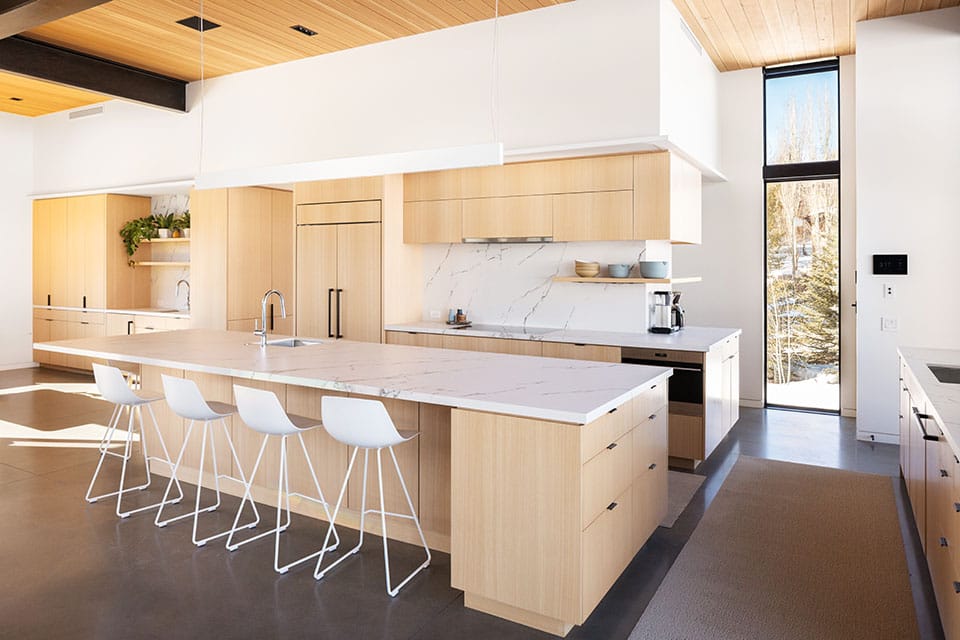
The sum of all the pieces is a home that’s a testament to E. Cobb’s commitment to modern design. There’s an authenticity of real structure and real materials on every surface that evokes a feeling of peace and contentment. The design is abstract yet deliberately detailed, with an abundance of natural light and awe-inspiring views in all directions, allowing the inhabitants to truly embrace the great outdoors. When asked what they appreciate most about their home, the answer comes easily: “it captures the sunrise and sunset perfectly.”
PROJECT TEAM:
Eric Cobb, Principal
Joe Wilhelmi, Project Architect
Josh Johns, Senior Architect
Sabrina Munley, Designer
Amber Rodriguez, Interior Designer
whj PROFILE
