
Listen to our Spotify podcast about this article:
by Cassidy Mantor
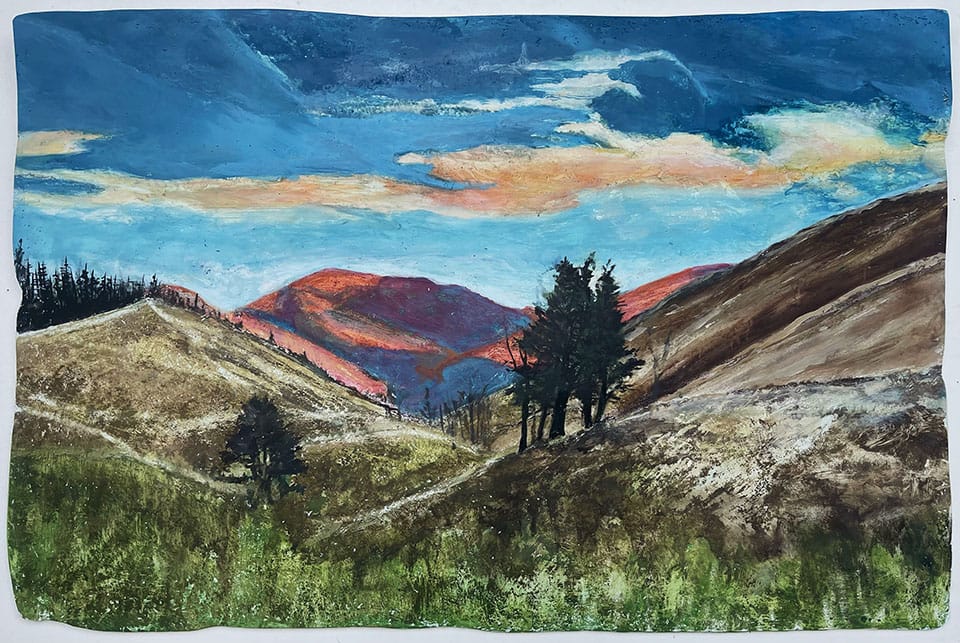
Redefining form & function with concrete art – A studio arts major in the early 1970s, Nasvik was already working in concrete construction to pay for tuition. Not long afterwards, he began pushing the envelope of what the material could deliver artistically. Pursuing that authentic avenue has provided architectural surfaces and wall-mounted concrete works that blur the lines between painting and sculpture, form and function. His journey reflects both a lifetime of technical understanding and also an ongoing search for creative satisfaction. Five and a half decades later, Nasvik shares how he’s still discovering what cement can contribute to fine art.
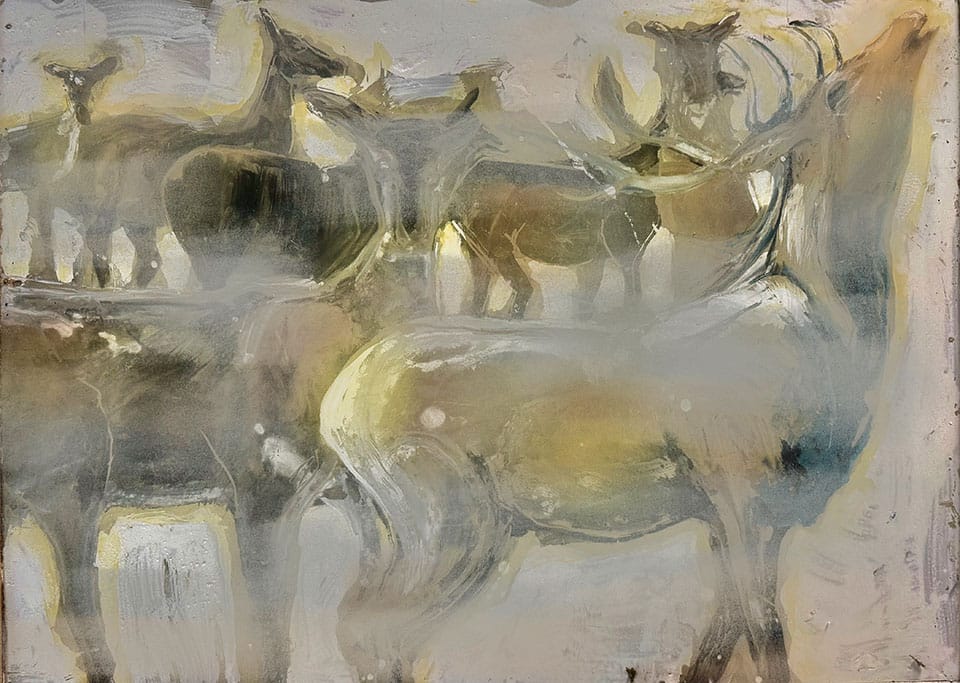
“I think concrete offers more opportunity than paint on a canvas. Grinding it, cutting it up, and piecing it together, layering it, drilling it, or texturing the heck out of it, are just a few reasons why. If you wiggle the corners of some of the pieces I’ve made, they will ripple like a stiff cloth tarp.”
A MATERIAL WITH SPECIAL PROPERTIES
Concrete as an art medium is extremely versatile. Unlike canvas, concrete offers more choices. Before it dries, it is liquid, can be cast paper-thin or extremely thick depending on its intended use. Its boundaries can take any desired shape. Nasvik usually considers how clean lines, or wavy or raw natural edges will contribute to the theme of a new project. He then uses integrally colored concrete to create lightweight fine art paintings. Initially, he also explored using concrete for freestanding sculptures because of its structural durability.
“I think concrete offers more opportunity than paint on a canvas. Grinding it, cutting it up, and piecing it together, layering it, drilling it, or texturing the heck out of it, are just a few reasons why,” he says. Nasvik explains that concrete can be very flexible too, especially at the ⅛” thickness that he typically works with. He notes, “If you wiggle the corners of some of the pieces I’ve made, they will ripple like a stiff cloth tarp.”

CRAFTING COLOR AND DEPTH
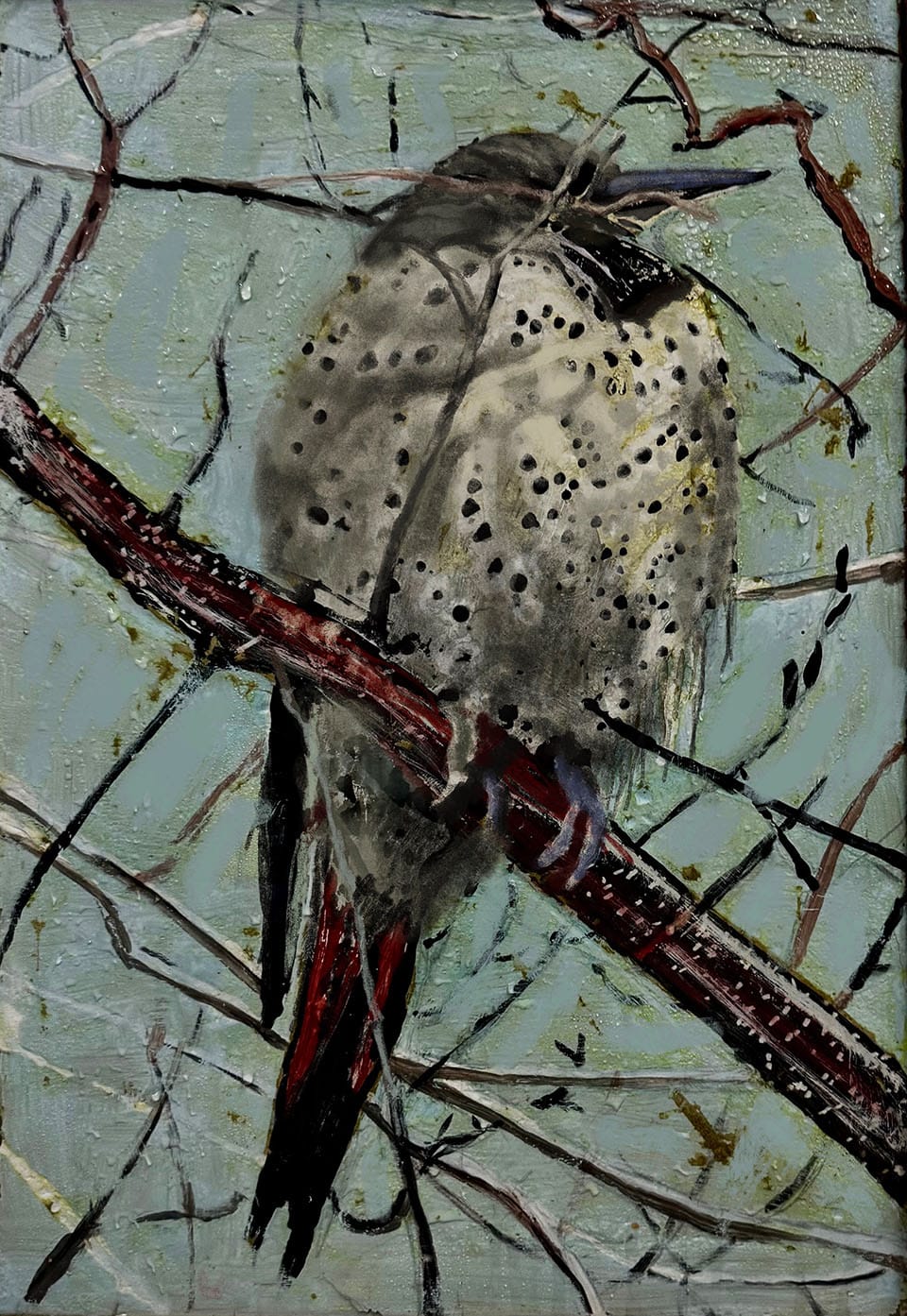
There are two underlying processes Nasvik follows to achieve his painterly surfaces and depth of form. “I usually apply my colored cement mixes over a sheet of melamine because cement doesn’t stick to it. I use white cement as my base, which takes color very well from liquid or powdered pigments,” Nasvik explains.
Thin layers harden quickly as batch after batch pile up on top of each other. He says, “You plan it out schematically starting with the foreground and finishing with the background. Eventually, new layers bury previous ones until detail in the piece is buried from sight.”
To establish structure, he mixes a thicker pot of concrete and covers the whole canvas with a layer that imbeds fiberglass glass cloth into it. He screeds that layer off so it is evenly ⅛” thick, and the next day he peels it from the melamine to reveal the image. Anticipation and excitement for the reveal can culminate in something happening that is unexpected. Nasvik says, “The process is a bit like printmaking because it’s done upside-down and backwards; consequently, some artistic spontaneity happens while the work is buried as it is created. It can be educational and fun exploiting those little surprises.”
“You plan it out schematically starting with the foreground and finishing with the background. Eventually, new layers bury previous ones until detail in the piece is buried from sight.”

The other way Nasvik works with concrete is to build it face-up over a previously hardened thin cast fiberglass reinforced cement canvas. This second process involves dabbing, wetting, and working in it like a traditional painting. Nasvik applies his colored mixes with brushes, hands, sticks, rakes, trowels, and whatever tools give him the desired effect. Gritty, sandy, and wet, Nasvik likens the consistency to self-leveling pancake mix.
BRIDGING ART AND ARCHITECTURE
“For decades I’ve been making things for people that are on the creative, useful, and functional end like: concrete countertops, sinks, floors, showers, tubs, walls,” Nasvik says. “I was attracted to decorative concrete because it satisfied my creative personality, but fine art has always been in my head and difficult to shake.”
That creative satisfaction is passed on to his clients. One client wanted to feel like he was showering in an aspen forest. Nasvik made large, floor-to-ceiling corner-to-corner tiles for a U-shaped shower. “I measured the panels out so they’d fit together and match up in place,” he shares. The client loved it and the project was a success.
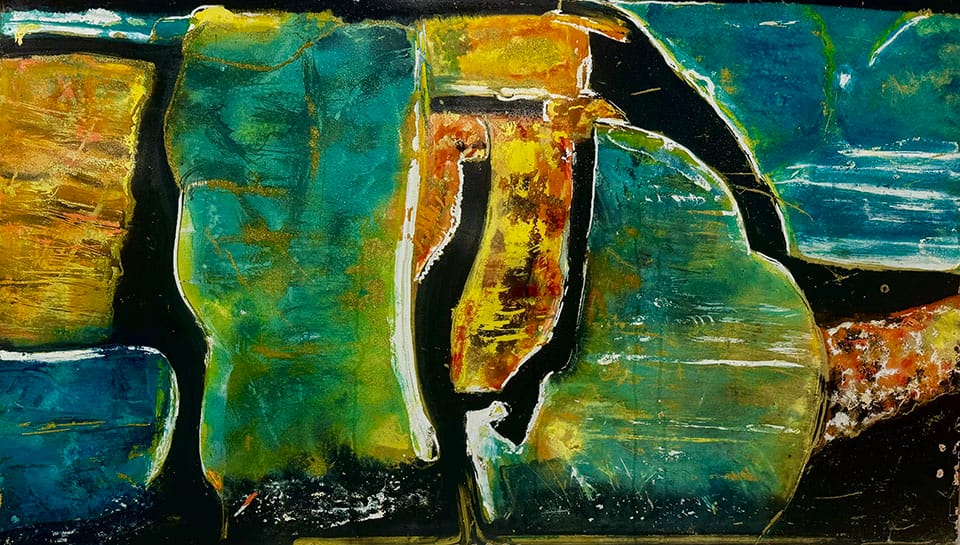
Nasvik’s artistic evolution has paralleled advances in concrete science. He was introduced to glass fiber reinforced concrete (GFRC) in 1975. And in 2015 at the World of Concrete trade show in Las Vegas, Nasvik saw an exhibit with a ½”-thick stick-like piece of GFRC about 12” long. The person running the booth dared anyone to break it with their hands. No one could.
“That was inspiring,” Nasvik recalls. “Based on that information, I went back home and made a lawn chair that looked like ½”-thick ribbon candy.” He would look at it and muse, “How thin can I go, I wonder?” His paintings are at ⅛” thick now, can they get it thinner?
Nasvik’s exploration of lightweight concrete became a family experiment. One Christmas, his daughter was home for holiday break from school in New Hampshire and, on a whim, they made cement paintings. She told her art teacher about it and that led to a week-long project period class where students created a 12’x4’ piece entitled Riparian Forest. The work weighs 110 pounds.
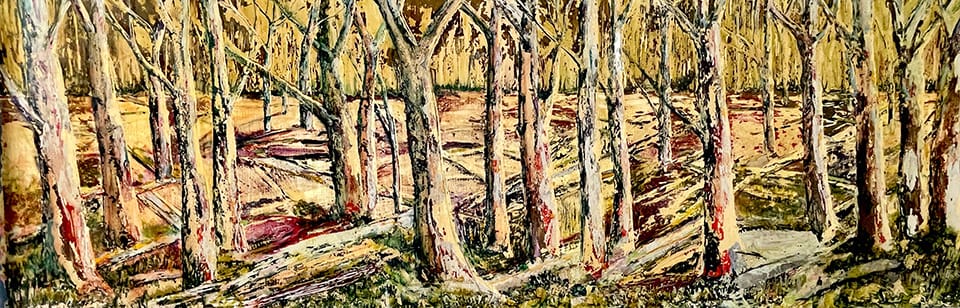
“The whole class worked on it and completed it in two days,” he says. “We were all shocked at how much we accomplished in so little time.” He’s been back to the school four times since then to lead other sculpture and painting classes. The more he works, the more he learns about pushing the medium. Nasvik predicts, “I’m sure I can go a lot farther still.”
For as exceptionally unique as his work is, Nasvik remains humble and focused on his art. “Some locals describe me as a concrete guru. It’s hard to measure up to people’s high or low expectations. I’m content just reaching for my limit,” he says. With that, he’s back to work on four concrete timber mantels that have the look and feel of real wood as well as the four fine art paintings for this article. As for the ribbon candy chair? It’s still in his yard all these years later.
whj FEATURE
