

Listen to our Spotify podcast about this article:
By Jennifer Walton
In Jackson Hole’s architecture, every great home begins long before the first sketch. It begins on-site, where light shifts through the aspens, wind blows off the Tetons, and the site’s surrounding environs dictate views, access, and the countless decisions that determine how a home belongs to its setting. That choreography between nature and intent sets the program for everything that follows. For Chris Moulder of Dubbe Moulder Architects, that’s where design starts: not on paper, but in conversation with the land itself.

Dubbe Moulder Architects Translates Terrain into Architecture
“Site planning isn’t a technical exercise,” Moulder says. He describes it as the moment a project finds its identity, and where the inspiration begins to form. However, that identity has to navigate a place unlike anywhere else in the American West. Jackson Hole is an international destination and a fragile ecological corridor. It’s a valley carved by glaciers and desire, where conservation overlays, wildlife migration paths, and urban growth boundaries trace over one another—the natural and man-made continually negotiating their edges. For Moulder, who has lived and practiced here for more than 35 years, his practice is about diplomacy as much as design.
When Moulder first walks a site with a client, he’s not exactly chasing a view or footprint. He’s observing the slope, the light, what should and shouldn’t be touched. “We look at weather, vegetation, drainage, sun angles, and of course the overlays that define where and how you can build,” he says. “There’s a whole set of physical and regulatory truths that guide everything.”
“We look at weather, vegetation, drainage, sun angles, and of course the overlays that define where and how you can build. There’s a whole set of physical and regulatory truths that guide everything.”
–Chris Moulder, Dubbe Moulder Architects
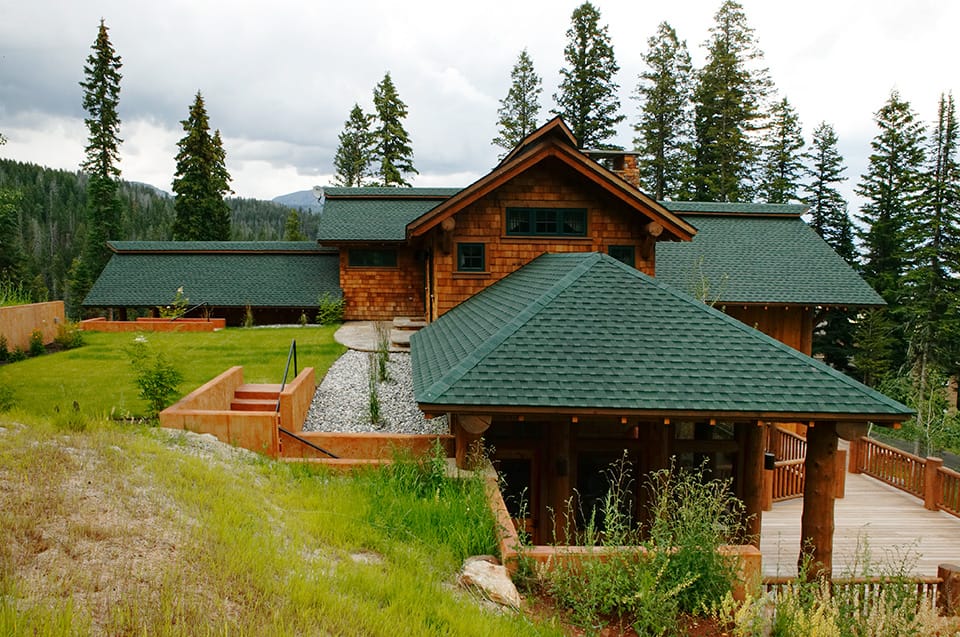
With the steeply sloped lot influencing the home’s design, we ensured that all three levels of the house provide direct access to grade.
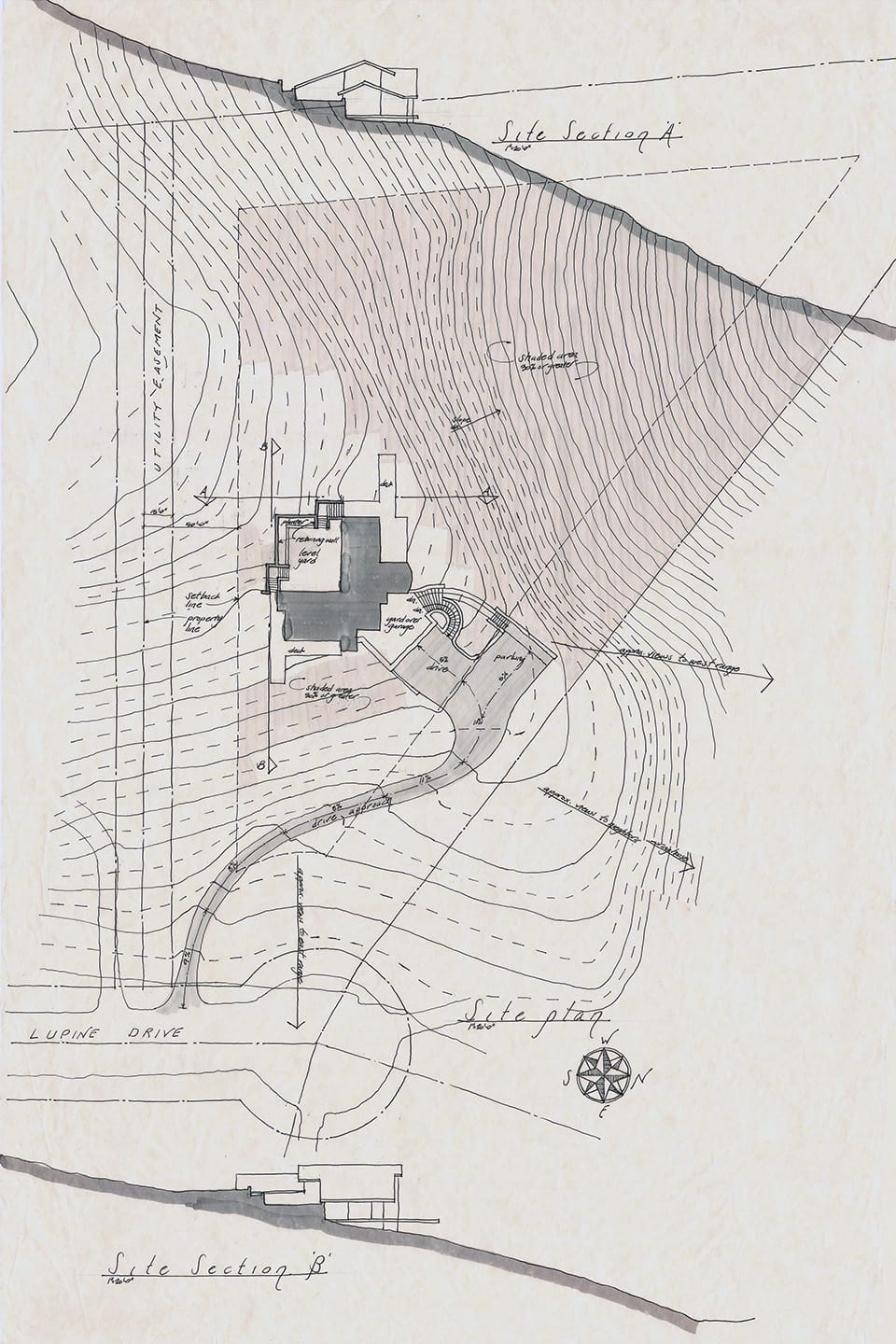
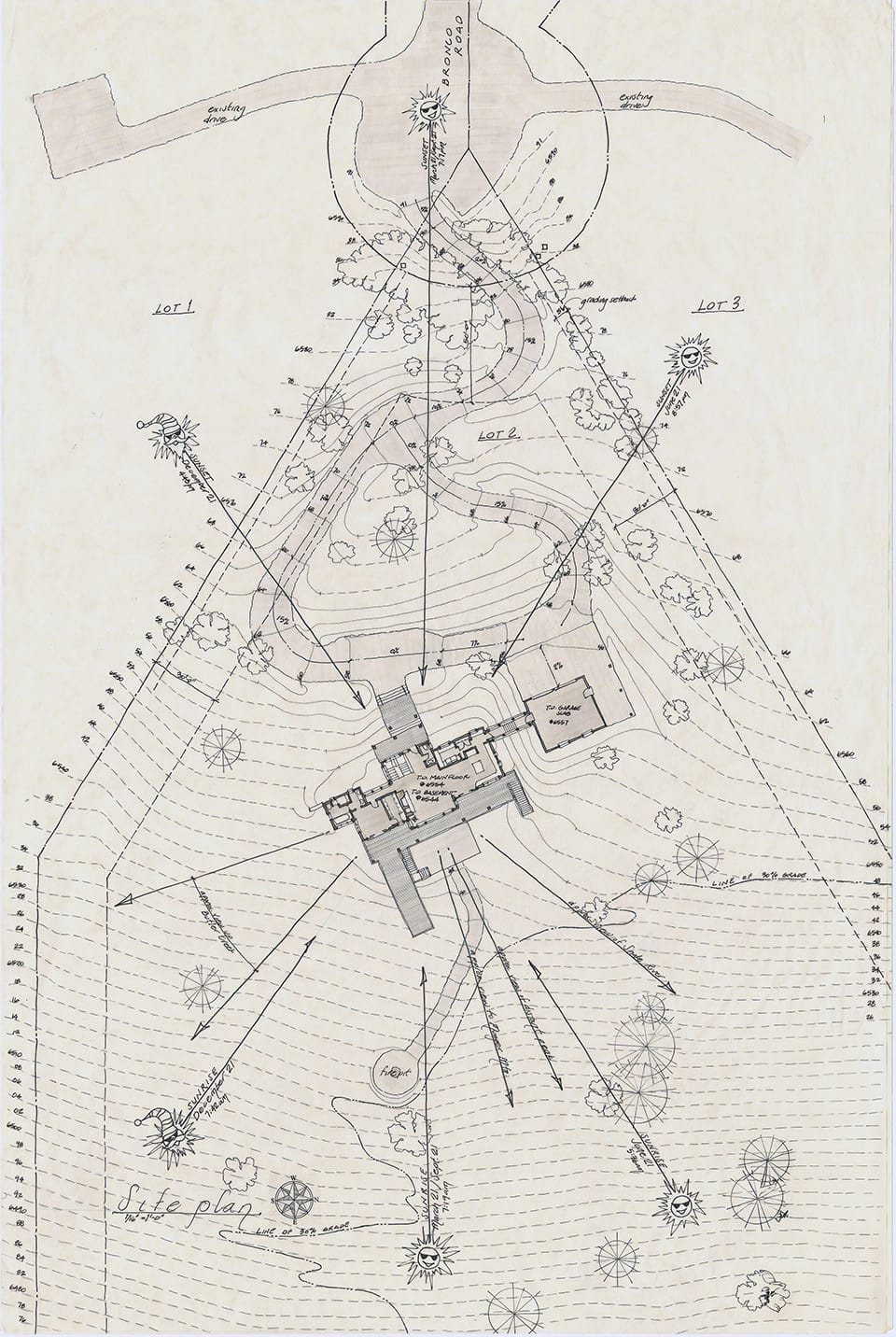
The site plan outlines the features and requirements for a project, serving as a guide for architects during the design process. It includes property lines, utility easements, setbacks, the slope percentage of the driveway approach, and the contours of the property, highlighting areas with a grade of 30% or greater that cannot be developed. The plan also indicates view angles, which are important for determining the placement of the house on the lot.
And often, those truths are invisible to property owners, especially newcomers. Many arrive with grand expectations: a glass greenhouse in a meadow, or a chalet perched high on a ridge. Yet, once Moulder applies the math of impervious surface restrictions, floor-area ratios, natural resource overlays, the dream can compress quickly. “It’s not about saying no,” he explains. “It’s about helping clients understand what’s possible, and what the land is willing to give.”
That candor has become part of the Dubbe-Moulder’s reputation. Clients sometimes invite Moulder or his partner, Kurt Dubbe, to walk properties before they even buy, seeking an honest read on what the property can support, and what could be its challenges. “It’s kind of due diligence,” he says. “We can show them the opportunities and the limits before they make a decision that nature or zoning might later undo.”
“How do we retain earth, manage rainwater, control ice and snowmelt, make it safe and still beautiful?”
–Chris Moulder, Dubbe Moulder Architects
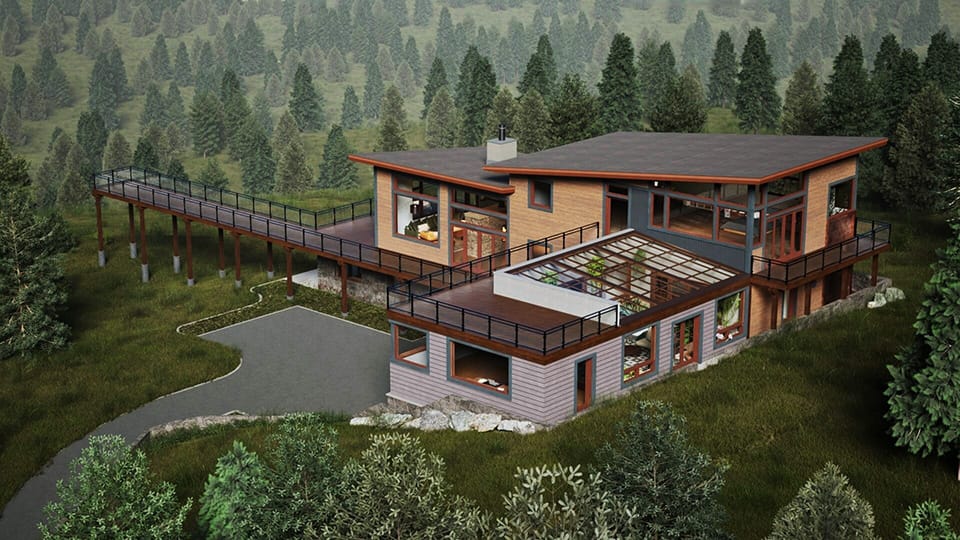
A 3D model facilitates communication among the owner, architect, and contractor, ensuring that everyone shares the same vision. This model illustrates how the house is integrated into the slope and demonstrates how glass fenestration optimizes views from the elevated property. These models allow the team to brainstorm and explore various design ideas.
Site analysis involves examining site boundaries, access points, building envelopes, utility locations, contours, and natural features such as slope, vegetation, and drainage patterns. This analysis also takes into account the parameters set by the Natural Resource Overlay boundary, which delineates areas where development is restricted, and the restrictions placed on slopes greater than 25%.
Every site tells its own story, but translating a client’s wish list into that story is an act of balance. “We start by asking about lifestyle. How they experience their days, where they want to feel the sun’s warmth, whether they garden, entertain, or need privacy for family or guests,” he says. “Those conversations create a program that’s personal but flexible.”
In the Teton region, flexibility is essential. Few “easy” sites remain. A flat, build-ready acre is now a rarity; most parcels come with significant slopes, access constraints, or environmental sensitivities. “I like the challenging ones,” he admits. “How do we retain earth, manage rainwater, control ice and snowmelt, make it safe and still beautiful? Those are the puzzle pieces that make each design unique.”
And sometimes those challenges come with a financial reality check. On steep sites like Saddle Butte, Moulder warns, “You can spend a million dollars just getting up the hill and putting in a foundation before framing even begins.” For clients used to quick results and limitless options, it can be a wake-up call. Even the most ambitious plans meet their limits here because in this valley, the land still has the last word.
“There are properties so extraordinary you just try to minimally impose yourself. Move a boulder if you must, but don’t clear-cut the lot. Once the framing is in place and window openings are set, then stand at those openings and see what existing landscape needs to change.”
–Chris Moulder, Dubbe Moulder Architects
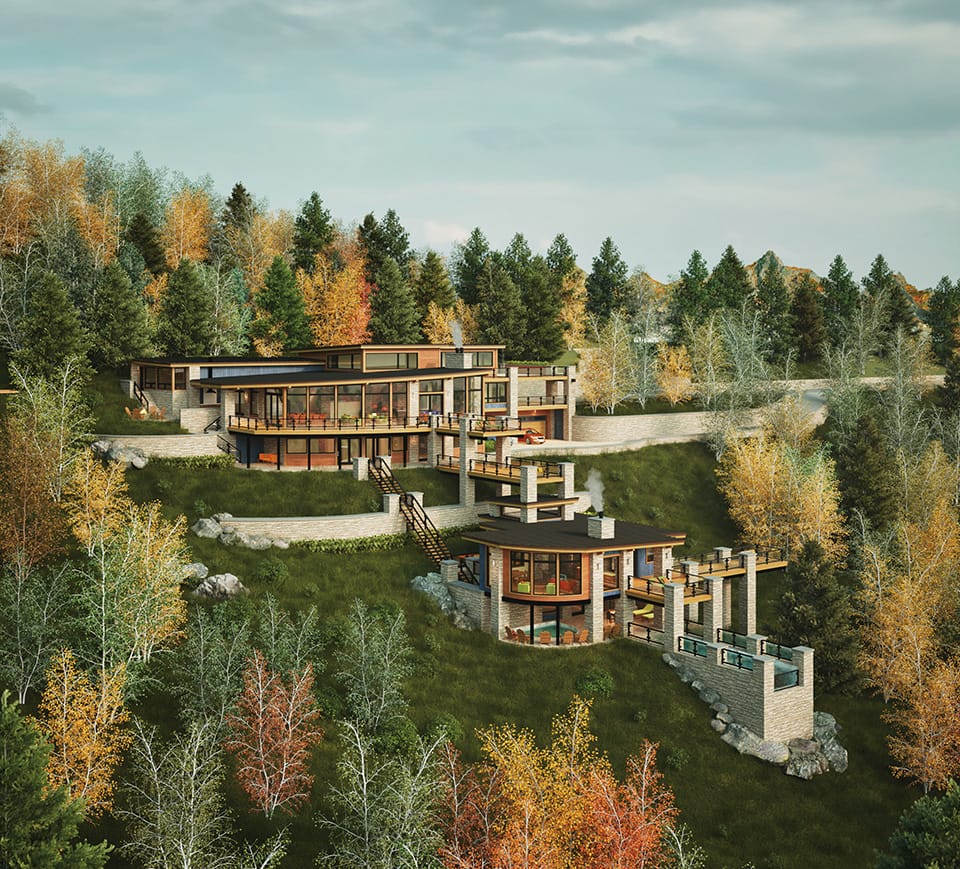
A 3D model demonstrates how the owner’s requirements can be met by descending the home down the slope with the help of retaining walls, keeping the design below tree lines to comply with skyline regulations.
Many of the remaining undeveloped lots in Teton County, Wyoming, are steep, offering breathtaking views but presenting challenging building constraints such as slope, building envelopes, height setbacks, and skyline restrictions.
Some of Moulder’s most memorable projects are defined by what he chose not to do. “There are properties so extraordinary you just try to minimally impose yourself. Move a boulder if you must, but don’t clear-cut the lot. Once the framing is in place and window openings are set, then stand at those openings and see what existing landscape needs to change.”
His discipline reflects a learned sensibility, one that reaches back to his earliest training, where design was understood as a dialogue between structure and the natural world.
That philosophy draws from an old lesson. His dean at architecture school, Bernd Foerster, taught his theory of “the seductive curve,” the idea that every successful design has at least one graceful curve or bend, a line that leads the eye and body through space. Moulder honors that ethos. “Nature has very few straight lines. A meandering path or a subtle curve in a wall feels natural because it mirrors how we move through the world.”
“Site analysis enables owners to identify opportunities and creative solutions for site challenges, empowering them to make informed decisions that advance their vision.”
–Chris Moulder, Dubbe Moulder Architects
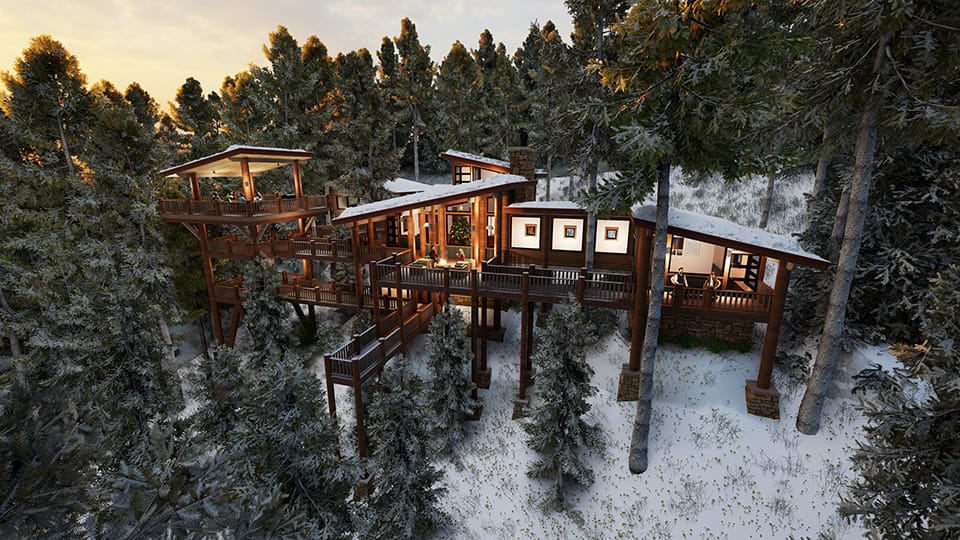
A 3D model converts two-dimensional plans into a realistic depiction of the completed home on the steep lot. The models can illustrate different seasons and times of day, helping owners understand the daylighting effects.
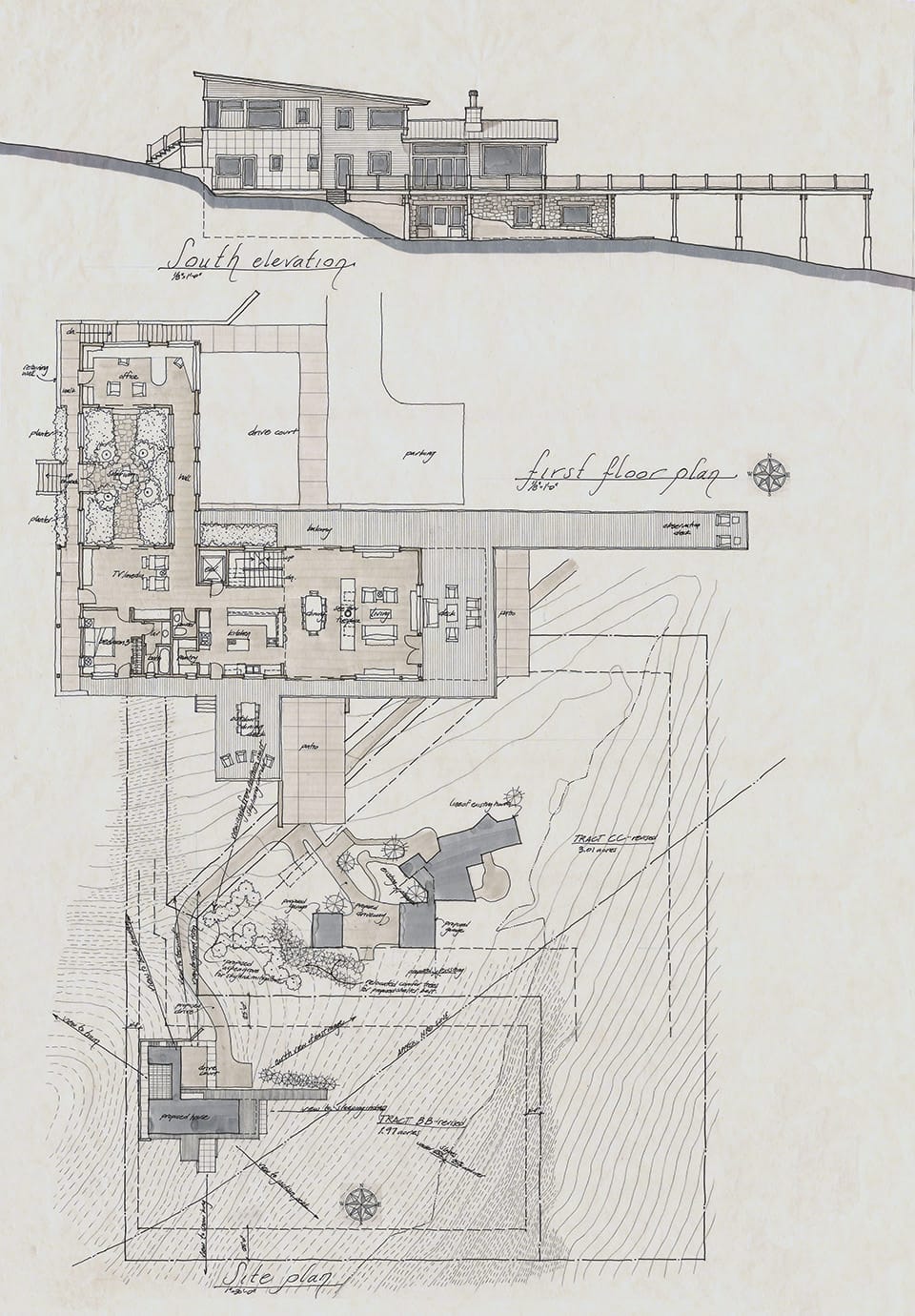
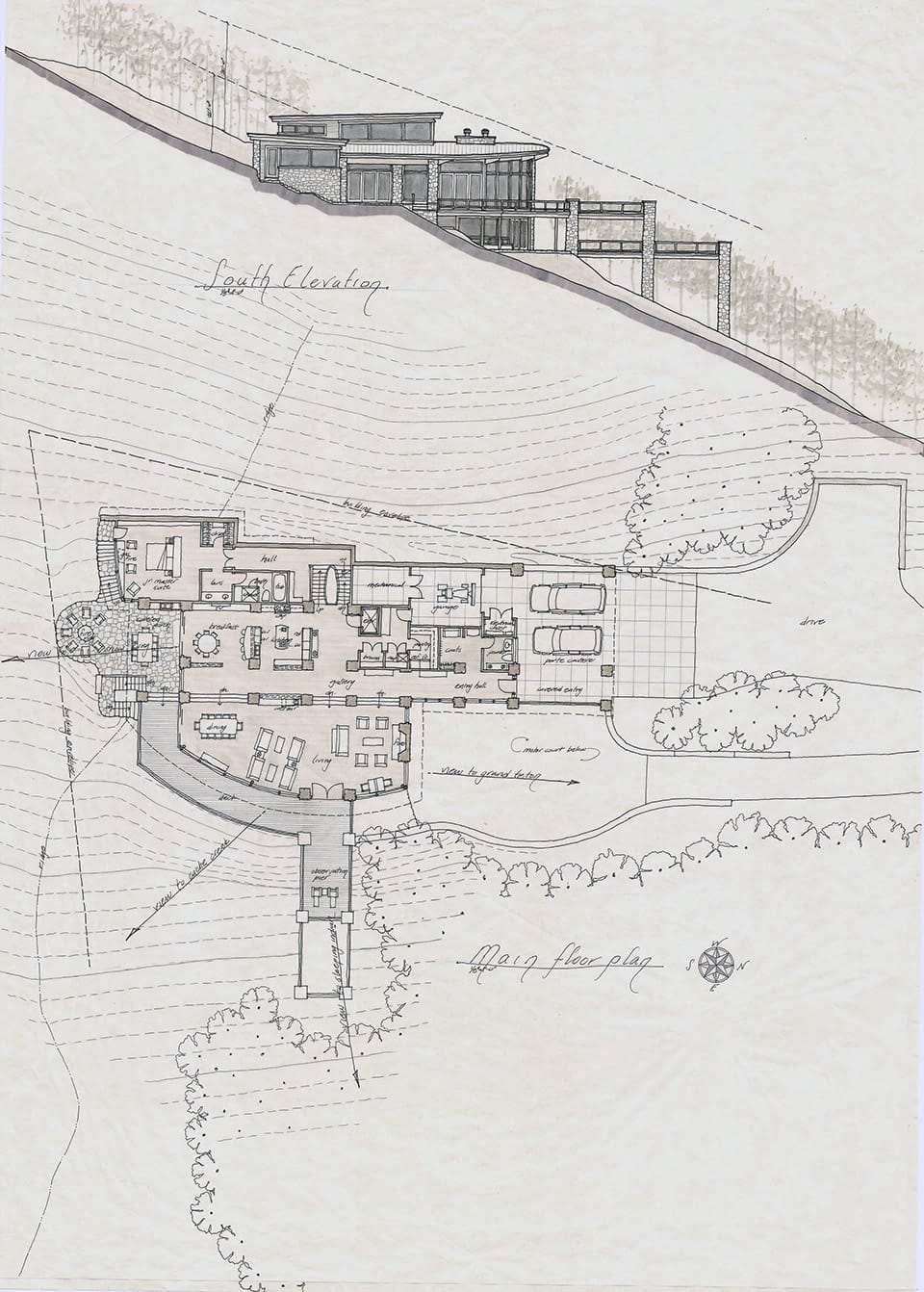
Another presentation drawing for a different elevated lot showcases the exterior elevation of the home, the main floor plan, and a section showing how sunlight will impact the house during the solstices.
Restraint then is almost a form of authorship. “We try to tell a story with each house. Many times, a designer’s first intuition is to smack you in the face with a view of the Grand Teton from the front door, but perhaps that view could be more powerfully revealed as you are first welcomed into a space and as you turn a corner, then feel the majesty of that view.” In the latter, the design heightens awareness instead of overwhelming it, and ultimately preserves the power of the moment rather than dulling it through repetition.
In the mountains, gravity, weather, and water conspire to draw the first lines of a home. “You work with those forces,” Moulder states. That collaboration begins at the micro scale, like grading for meltwater and orienting entries against prevailing storms, and then expands to the macro, like preserving wildlife corridors, managing light pollution, and protecting neighboring sightlines. “It’s easy to think about your own view, but every decision could potentially change someone else’s. We’re all part of a larger pattern.”
Technology has transformed how Dubbe Moulder communicates with those patterns. Three-dimensional modeling allows clients to “fly” through topography, testing how a home might feel in the afternoon light or under winter snow. “It’s an amazing tool for helping people visualize abstract ideas,” he states, though he still prefers to begin with a contour map and pencil. “After decades here, I can look at a two-dimensional topo and see it in my head.” For him, the computer confirms what his intuition already knows.
“Every project, whether it’s on 30 acres or an eighth of an acre in town, carries responsibility. Scale doesn’t change that.”
–Chris Moulder, Dubbe Moulder Architects
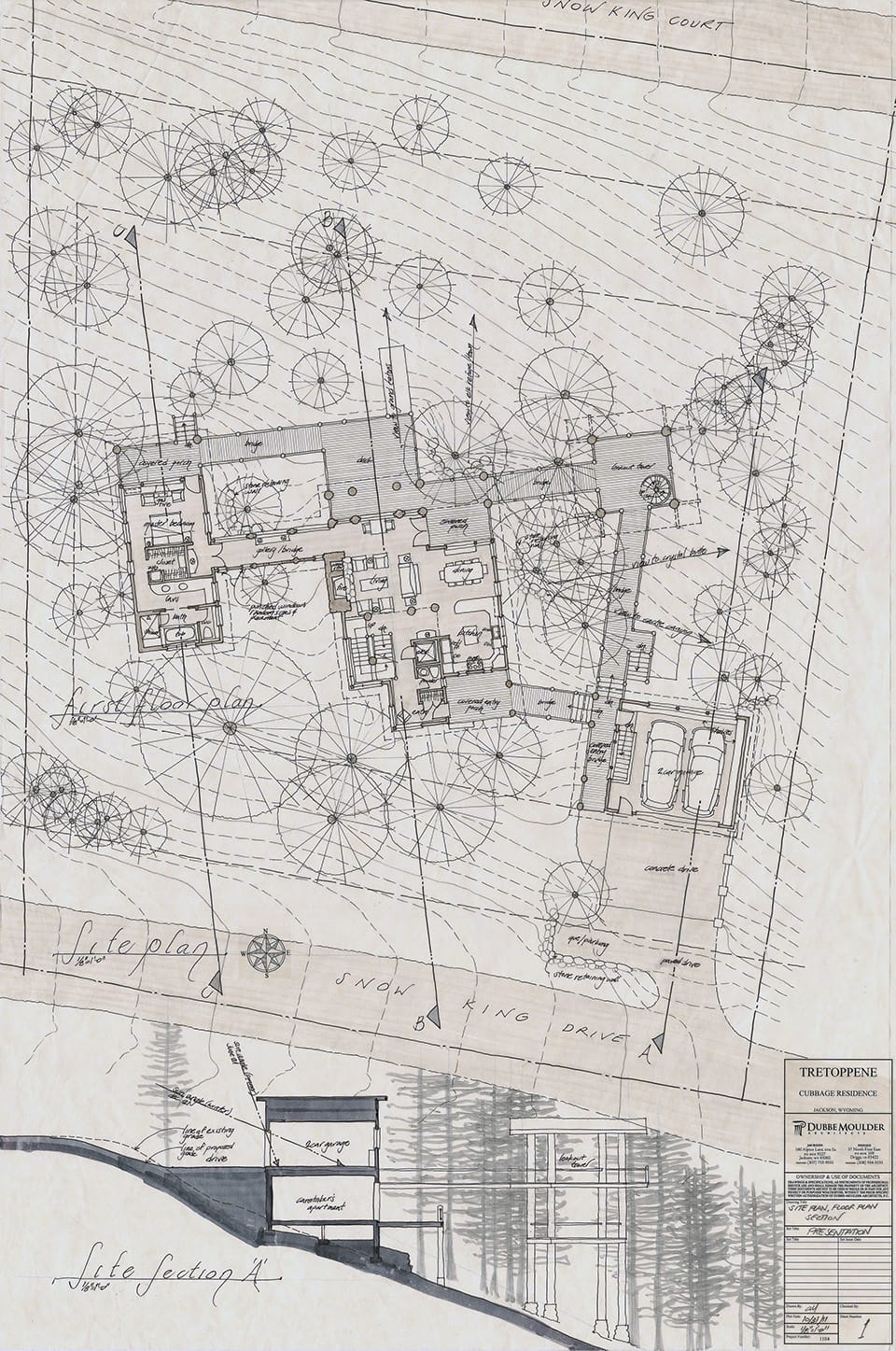
Using data from the site survey, this site plan outlines elevation, site boundaries, sun angles, view angles, and the design and slope of the driveway leading to the home. We focus on maximizing desirable views while also considering those that need shielding, along with sun paths and wind directions, to create a design that ensures natural light, warmth, and protection from wind, rain, and snow.
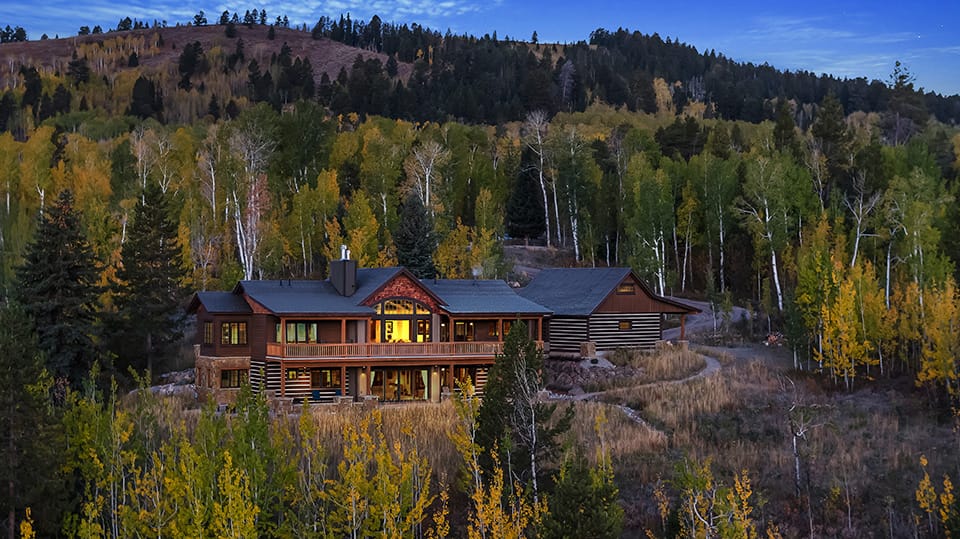
The completed home, as shown in a twilight image, is strategically positioned on the lot to optimize views to the east of Jackson and to the south of Munger Mountain. The driveway descends toward the house, with drainage managed via a ditch located under a bridge connecting the garage to the home.
The real artistry, he insists, is not in the rendering but in the reading; the ability to interpret what a site is telling you. “Models are persuasive, but you still have to stand there, feel the wind, smell the sage, and understand why a certain spot feels right,” he shares.
After more than three decades in Jackson Hole, Moulder speaks of the valley with affection, realism, humility—all from experience. He’s observed wildlife corridors shrink and floodplains widen, seen neighborhoods evolve from ranchland to enclaves, and understands that even minute decisions like a driveway cut or a fence line ripple outward. “Every project, whether it’s on 30 acres or an eighth of an acre in town, carries responsibility. Scale doesn’t change that.”
In older subdivisions like Rafter J, where lots are compact and irregular, that sensitivity becomes design’s invisible craft. “I’ve done dozens of homes there,” he recalls. “Each one required rethinking window placement, roof lines, privacy. Even in a dense neighborhood, you can create light, view, and connection if you understand the site.”
Building in the region, Moulder believes, is a privilege and a reckoning. It tests the limits of control and the necessity of respect. The valley is a wildlife and migration corridor, we’re all guests, and the land has a long memory.
Building in the region, Moulder believes, is a privilege and a reckoning. It tests the limits of control and the necessity of respect. The valley is a wildlife and migration corridor, we’re all guests, and the land has a long memory.
So, before you decide where to place your home, take a moment to understand the ground beneath it, the neighborhood around it, and the watershed it belongs to because the very reason you came here, or chose to stay here, is more than likely because of the natural beauty and access to it.
In a region where real estate has become synonymous with rarity, beauty is not a commodity. It’s the one resource that can’t be rebuilt once it’s gone. And for Chris Moulder and the staff at DMA, that’s the point: architecture at its best is a form of gratitude, a way of living lightly, carefully, and leaving the valley as wondrous as you found it.
whj PROFILE
